

She had hazel eyes. I was in my early 30s and where I came from, blue eyes were rare and hazel were virtually unknown. I had often stepped outside my own dark-eyed world and had met quite a few blue-eyed human beings. But I had never seen hazel eyes before, the golden, olive green and brown kind of hazel that changes colour with the light. I looked intently into her hazel eyes. Is there something wrong with them, I thought? They were mesmerizing, impossible to avoid, impossible not to stare at. Sometimes her curtain of thick black hair momentarily fell forward and her hazel eyes were more interesting. At times, when she casually pulled her scarf across her nose and mouth and looked at me, all I saw were those hazel eyes. I examined each iris, fully aware that I was being impolite and disrespectful, but I couldn’t help myself. I don’t think she minded because she continued to visit me almost every day.
She had just finished college, she said, and her father, a high-ranking Iranian politician, had agreed she could travel for a year before she settled down. She had chosen India and Nepal because their civilisations were as ancient as her own. At the time, all I knew about Iran was the Hollywood film Not Without My Daughter starring Sally Field, which had only strengthened my considerable prejudices against the Islamic world and reinforced my conviction that Ayatollah Khomeini was an evil man.
The girl might have been as curious about my exotic background as I was about her hazel eyes. She had never met a half-Tibetan, half-Bhutanese Himalayan native before but, unlike those who visited me for Buddhist teachings, she did not ask one question about Buddhism. Now I come to think of it, she didn’t ask me anything at all, although she appeared to drink in every word of the philosophical conversations I had with my other guests. I still remember the strong smell of the perfume she wore that lingered long after she left the room. I asked my Persian friends about it and they said it was a rare and costly fragrance called Oud that wealthy Persian women had worn for centuries.
I began to look forward to her visits. If she was late, I grew restless. My attraction was now rather more than a mere fascination with hazel eyes but I was in denial about all such feelings, even to myself. Her Persian ancestry had increased her allure.
The day she left for Iran, we met in a coffee shop to say goodbye. She hastily wrote her address on a paper napkin and thrust it at me. “Keep in touch,” she said and left without looking back. In those days, it was only possible to keep in touch if you had a person’s home address and phone number – meaning a landline. Generations Z and Alpha will probably find this difficult to imagine.
On 31 August 1996, as the plane from Kuwait began its descent into Tehran Imam Khomeini International Airport, I noticed snow on the peaks of the Alborz mountains. I was surprised. It is famously hot and dry during the summer months in what I then knew as the Middle East but have since learnt is West Asia. I had not expected snow. Immigration detained me far longer than anyone else because none of the officers had heard of Bhutan. Was I the first Bhutanese tourist to land in Tehran?
I was excited about my trip to this unfamiliar country where I had nothing to do. Spiritually, there was little here to interest me, except vague allusions my Tibetan teachers had made to the visit of Gesar, the King of Ling, was said to have made when Iran was still part of ancient Persia. My interest in seeing Iran for myself had been piqued earlier that year in London when I was supposed to be studying English. In reality I was cinema-hopping through the West End and the South Bank, immersing myself in every style of moving picture I could find. It was around then that I first encountered Mohsen Makhmalbaf’s magical film, Gabbeh.
In a makeshift tent against the backdrop of Iran’s beautiful grasslands, an elderly man raises his right hand to point into the sky.
“What is this colour?” he asks his class of fully engaged, eager children.
“Blue!” they reply. As the teacher lowers his hand, we see it is the same colour as the sky, Persian blue, and the shade has lived in my memory ever since. I began to seek out other Iranian films and discovered Abbas Kiarostami’s Taste of Cherry and Majid Majidi’s Children of Heaven, both real gems. At the time, it didn’t even occur to me that a country capable of producing such simple yet profound films must be quite culturally sophisticated.
Outside the airport, the road was lined with cars, none of which were official taxis. The cars’ drivers surrounded me and began vying for my business. These unofficial taxi drivers were ordinary people, said my Persian friends, just trying to make ends meet. For no particular reason, I chose a bulky, middle-aged man who drove a cream-coloured Volga. The Iranians are an eloquent people and like Indians, they love to talk. I didn’t mind. My driver told me all about his city and its history and I enjoyed listening to him. As he talked, it gradually became clear to me that he had a PhD, but I can’t remember his subject.
After Kuwait, with its giant marble mansions, modern high-rise buildings and luxurious hotels, the epitome of a nouveau riche society, Iran could not have been more different. More like India than the Arab states, it was, if anything, even less developed. On the way to the hotel, my driver persuaded me to stop for refreshment. The menu at the restaurant he took me to was a surprise. Everywhere I looked, I saw familiar foods, including huge, oversized naan and kebabs which I thought were native Indian dishes. No, no, said my driver, India imported all such dishes from Iran. The waiter brought me my tea which was served with a lump of rock sugar.
“Put the sugar in your mouth,” explained the waiter, “and leave it on your tongue as you sip your tea.”
By the time my garrulous, pot-bellied driver dropped me at my hotel I had become quite fond of him. As I paid him, he offered to take me sightseeing, and I hired him for my entire stay. He took me to all the main tourist attractions, including the ruins of Persepolis which, he said, had been built by Darius the Great during the time of the Buddha. World history had not been on the curriculum at Sakya College, and I was astonished to learn about the power and accomplishments of ancient Persia.
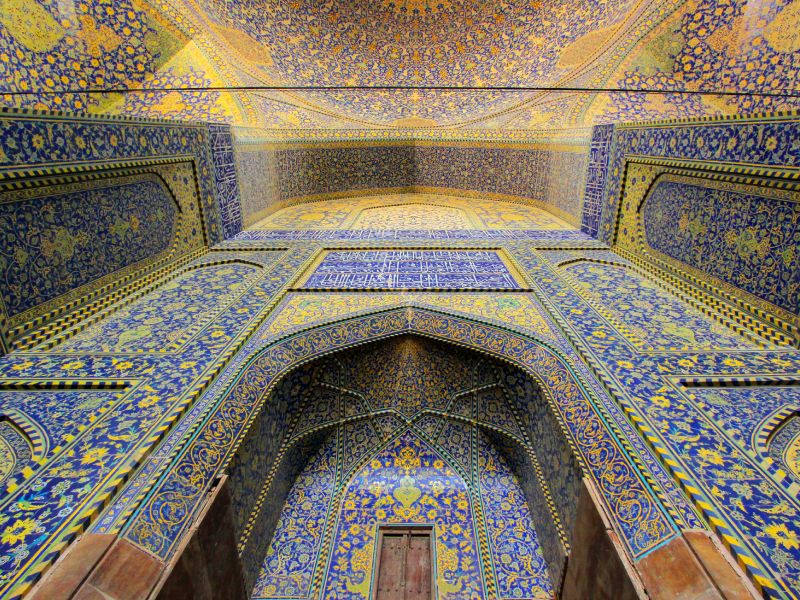
image credit: irandoostan.com/shah-mosque-isfahan
For me, the biggest draw in Tehran was its magnificent bazaar, the Bazar-e Bozorg-e Tehran. The building itself was glorious and its beautifully laid out shops were full of fascinating sights and smells – spices, foods, perfumes and incense. My Tibetan friends had told me the best quality turquoise comes from Iran – the Jowo Buddha’s crown is said to be encrusted with Iranian turquoise – and that Iranian saffron is second to none. Thanks to Gabbeh, I found myself in a rug shop. As I browsed, the rug seller noticed my eye return to one particular rug and opened negotiations. Rather sheepishly, I admitted that I was running out of cash. The rug was very reasonably priced, I said, but I didn’t have enough money with me.
“Sir, you should have told me. There is no problem at all. None. I will send the rug to your home and you will pay me when you can,” said the rug seller, delighted to solve my problem for me. My sceptical mind congratulated this shrewd Persian businessman for his excellent sales pitch. Nonetheless, I bought the rug, although my conscience would not allow me to leave the shop without making a down payment.
“Not necessary, dear sir, not necessary,” said the rug seller. But I insisted, promising the balance as soon as I returned to India. Two months later, the carpet was delivered to my home.
The most fascinating places in Tehran were the book shops. Obviously, the vast majority of volumes were in Farsi, Urdu and so on, but there was often an English-language section somewhere at the back. Instead of books, though, I found piles of photocopies. Why, I don’t know. Perhaps the published books had been banned or were too expensive to import? The photocopies intrigued me and when I found a copy of Snow Country in English translation, I was unaccountably moved by the trouble this Iranian book seller had taken to get hold of the text of one of my favourite books.
I asked my driver to take me to Isfahan, five hours south of Tehran. He talked throughout the journey, only pausing when I dozed off. Everything he said engaged my interest.
“Americans are very smart,” he said. “When Arab bellies are full, they can’t think. When Persian bellies are empty, they can’t think. The Americans make sure the Arabs have a lot to eat and the Persians are always hungry. Americans are very smart.”
Did I meet up with my hazel-eyed girl? No, I didn’t. After she left the coffee shop on that sweltering day, I sent her a postcard but she didn’t write back. I met lots of hazel-eyed girls and boys in Iran. Each time, her image flashed into my mind.
I have visited three countries this lifetime that radically shifted my preconceptions and Iran was one of them. Whenever people talk about the Iranian regime and how it mistreats its own people, my Gemini mind remembers all the atrocities perpetrated by the Americans, the British and their allies. How would the English-speaking nations respond to being invaded by a more powerful and greedy country? How would they respond if that country then bled them of their natural resources? How would they respond to the imposition of draconian sanctions on their imports? Would they still be as smug about law and order and human rights if they were the ones being persecuted and oppressed?
Today I wonder, is the Sheikh Lotfollah Mosque still standing? Has the Bazar-e Bozorg-e Tehran escaped the bombs? And what has happened to the hazel-eyed girl.
I thought today you would fall in love