
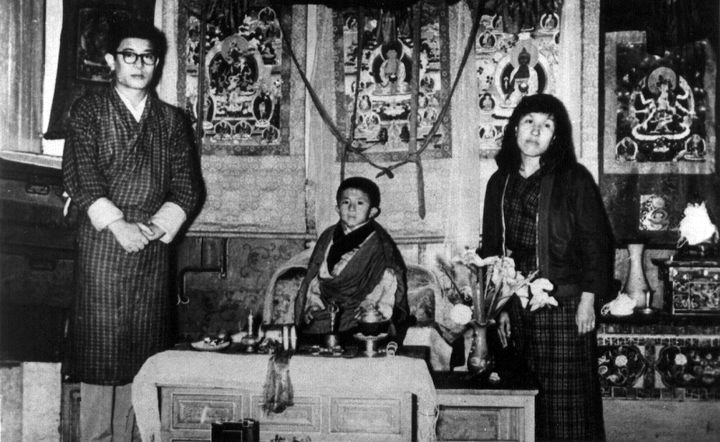
 I don’t know what I will be called in my next life. I actually don’t know if I will be reborn in a sphere where there is such a thing as a name. Do beetles have names? Probably my current name Dzongsar Jamyang Khyentse will be given to a child of an ambitious, influential human being or a manipulative relative. And I will die in the tea of the child who gets that name.
When I was young, my nickname was “Lepo,” which means idiot. In Bhutan, most people don’t mind being called idiot, or fatty, or rice ball, or disrobed monk, or frying pan. In fact when Bhutan finally had to bow down and conform to the global phenomena of census taking and ID cards, many people ended up putting their nicknames on their passports. So now I have a khenpo at my monastery whose passport says “Yongba,” which is another way to say idiot. Surnames rarely exist in Tibetan and Bhutanese, let alone maiden names.
Every monk is given a beautiful name at their ordination or refuge ceremony, which is rarely used. In the early days, when I was trying to build my own monastic school in Bir, I had a handful of monks working there. Whenever we addressed the monks with their Dharma names, like “Holder of the Lamp” or “Victory Banner,” no one would respond. The only way to get their attention was to say, “Helicopter!” or “Salt Sack!” and they’d come right over.
Then there is another set of names that people don’t even know they have. Monks at shedra secretly call their lopons and khenpos by all kinds of made up nicknames behind their backs. For instance the abbot of Dzongsar Shedra, Khenpo Kunga Wangchuk, who was this great, serene, practitioner, so dedicated to the Dharma, but some of the monks secretly referred to him as “Gabbar Singh,” who was a sadistic villain from a 1970s Bollywood film, I guess because they were afraid of him.
My sisters and brothers all had nicknames. My older sister Kelsang Choden was called “Lemmo” which means female idiot, but it wasn’t an insult because she has always been very smart and refined. She attended St Helen’s School, a Christian  school in Karshiang, West Bengal, and we younger kids always eagerly awaited her return during the holidays because she would read to us from these small English books. My introduction to Little Red Riding Hood was through her. The stories and drawings from the west were so powerful. I could listen to Little Red Riding Hood again and again and again and never get bored, then I would lay awake at night, afraid of the wolf.
My younger sister, Yeshe Pelzom, was called “Baktangmo,” which means something like “the fat one” because she was a bit round when she was young. The image of chubby, stubborn Yeshe Pelzom with her dark purple chuba is strongly imprinted in my mind to this day. In the brief time that I spent at home with my family, I felt very protective of her. Of course she is now not at all round but she’s still a little stubborn; stubbornness is a trademark of the children of Thinley Norbu, who was known by his peers as the embodiment of stubbornness.
My younger brother Garab Dorji was named “Meme Garab,” which means old man Garab. I don’t really remember why he was called that. My younger brother Jampal Dorji was called “Gangongla” which means the pebble. The image of him drooling when he spoke as a child and still drooling today will never leave my head. My youngest sister Pema Chökyi was called “Niyamo,” which means mouse. And finally my youngest brother Ugyen Namgay was called “Taila” which means beans. Unfortunately I have almost no memory of either of these youngest two because by the time they came along, I was long gone.
Popularly and sometimes officially, I am called Dzongsar Jamyang Khyentse, but it is a somewhat general name, it’s not personal to me. Dzongsar is a place, like Nashville, and Jamyang Khyentse was Jamyang Khyentse Wangpo’s own name. Later, when he reincarnated, it got passed along to all his incarnations and since I happened to be one of them, I got this name.
When my parents brought me as a baby to my father’s father, Dudjom Rinpoche, he gave me the name Khyentse Norbu, which is the only name my father ever called me. I think Dudjom Rinpoche was trying to give all his descendants the name Norbu: Thinley Norbu, Shenphen Norbu, Pende Norbu, and then me. But when I was growing up with my grandparents in eastern Bhutan, some people called me “Lama Daza,” which means little lama. And a few others called me Dungse Rinpoche, which is how one calls a family lineage holder, such as my father, Dungse Thinley Norbu Rinpoche, i.e. son of Dudjom Rinpoche.
Then, when I was enthroned in Sikkim, Sakya Trizin sent a red cloth with “Jamyang Thubthen Chökyi Gyatso” painted on it above a lotus, sun, and moon disk supported by two lions. The 16th Karmapa also bestowed a name on me: Tsangpa Lhayi Metok, which means “flower of heaven.” Later, I went to the Dalai Lama for blessing, as is customary, and he gave me the name Shenpen Chökyi Nangwa which means “projection of Dharma that benefits others.” But most of the time, my tutors and other lamas referred to me as Yangsi Rinpoche, which means “the reincarnated one.” Some of the older lamas like Orgyen Tobgyal Rinpoche, still call me Yangsi. When I was a young boy receiving teachings from Kyabje Dilgo Khyentse Rinpoche, I learned that the other young tulkus sometimes called me “Trimthar” which means “above the law” because Kyabje Dilgo Khyentse Rinpoche never used to scold me, not even raised his voice, never a harsh word, not even a disapproving vibe, no matter what trouble I got into. I think there is a perception that no one else could get away with the things I did. Later, when I worked on the set of Little Buddha with Bernardo Bertolucci, the Italian crew had a difficult time pronouncing my name so they decided to call me “Piccolo Padre”, which I think means “little father.” And because of some mischievous Singaporean and Malaysians, some people now call me “Boss” behind my back.
Imagine the difficulties I had when it was time for me to start traveling the world and I finally had to apply for a phenomenon called passport.
This is so funny — what’s in a name, after all? I started this hallucinating-life of mine with a name mismatch; my parents wanted to call me “Loredana” but the nurse who had to fill the papers in — don’t ask me why — wrote “Barbara”, and that’s it… Yes, “piccolo padre” in Italian can mean “little father” but “padre” also means “respected monk” and “piccolo” can mean “young” or “short”, so they could mean “short respected monk” or “young respected monk” too. A lot of people on the Internet calls you DJKR or DJK which sounds like a hip-hop kinda name 😀 ——— Do beetles have names? Maybe they do, who knows. In any case, Khyentse (to an Italian ear) sounds easy to pronounce: we read words as they are written, so in Italian your name is pronounced KIENTSE (kee-eh-nts-eh), as it is.
Yes, beatles have names.
We all know them!!
JohnPaulGeorge and Ringo!!
So what is the name written on your passport?!
i want to know as well. hahaha
thanks a lot for introducing us into another – here very personal – field of masks; that´s very precious for those you cannot see you new film right away
Brilliant. Thank you. _/|\_
Thank you for giving us a glimpse of the ego-less realm of “no-names”, and reminding us of how we can, without even realizing it, be attached to the self with our names as the ego-trap, and how easily it may be dismantled.
In today’s times, the most beautiful world, just might be the idiot’s.
Your stories are ever so precious and this one brought a big smile with it.
So what is your preferred name, Boss ?
??
Just last night I was hoping for a new Episode. Thank you Rinpoche!
Thank you Rinpoche sharing your thoughts and experiences of growing up with many names. Every time I read anything Rinpoche has written always inspiring. Thank you looking forward for more.
“The Way – cannot be told / The Name – cannot be named”?
Anyway: “Piccolo padre” in Italian can also mean: short OR young (piccolo) “respected monk” (padre) — so it’s nice, it could be “young father” or “short respected monk” — Italian is quite a weird language…
Thank you so much _/|\_
Wolf, not fox.
This is boring.
Why so much fuss around nothing?
Names are the shadow of reality, said Laotse or so.
Sir
You are an identity
You are nameless
You are revered
You are brutally ,satirically clever
Very appropriate for time and space now
You need no name
You are defined without name
There is quite a statement in this part of the story, if you grasp it. First lines. From “I actually…” to “…that name.” 😉
The whole of samsara is a fuss around nothing. We are all individually and collectively, a fuss around nothing. But at the same time, it is also everything.
And what gives rise to boredom is subjective. Mathematics bores almost everybody, but for some it is an obsession.
Every event in samsara, is serious and funny at the same time. Ever accidently slipped on a banana peel in public, or listened to a politician’s speech about his plans to save the world ?
Something that does not hurt other beings, at the same time brings a smile to your face, and also gives a small lesson on life, is priceless. It’s worth the boredom.
Yes, Laotse did say, and this “boring” story is what he exactly meant – “names are a shadow of reality” – and that reality is also subjective, completely dependent on the “eye” of the beholder.
Oh, incedently, for the people in lands where panthers do not exist, the panther is just a “cat”. And so with the wolf that may be called a fox. And with the intelligent guy who may be called the idiot, or the human who may be called a pebble, or a dog who may be called hercules. Names are but just “the ‘shadow’ of reality” – subjectively.
Dear rinpoche,thank you for sharing your life story and eagerly waiting for more la.May rinpoche be joyous,healthy,safe and loved always.CHAB SU CHOE.
More episodes and longer ones please ?
And then there’s the ubiquitous but heartfelt “Rinpoche,” because what else can we call you? A nickname you may or may not appreciate, and I have uttered or heard: Rock Star Rinpoche. You rock, Rock!
???
Oh my Goodness, I had no idea how complicated this name thing can be for rinpoches. I read it to my son and we both had a good laugh, thank you so much, Rinpoche!
My family name is Pinheiro, which means Pine Tree. When a child, people called me “brute mass”, because I destroyed everything around like a Tasmanian devil. Then in high school “Amebão”, which means, of course Big Ameba. My Tibetan friends sometimes called me Phagpa Karpo, white pig. I guess I’m lazy and dumb, but good natured. haha.
Good to know names are somewhat of a issue for both important and unimportant people. Never had to apply for a passport, though. Lucky me.
Thanks for your inspiring and hilarious accounts, Rinpoche. I’m keeping a vow of no entertainment for a while, but when it’s the lama display, I guess it is ok.
Beyond the attraction of a prestigious name, and the effort to renounce the same, easing His way through the glues of samsara.
In my country one has to, at times, hide one’s last names because they can be used by black magicians to cast harmful spells…anything like that in Tibet or Bhutan, or elsewhere? Women also have to hide their blood-stained sanitary napkins, and when one gets a haircut or trims one’s nails, that DNA must be hidden, or burned, as well, for the same reasons. It is difficult to live that way…so many predicaments the unenlightened must deal with.
That was so great; so human.
Heart smiles to you Khentse Norbu
Whether the “Precious one” is called by the name ‘Khyentse Norbu’, ‘Lama Daza’, ‘Dungse Rimpoche’, ‘Jamyang Thubten Chokyi Gyatso’, ‘Tsangpa Lhayi Metok’, ‘Shenphen Chokyi Nangwa’, ‘Trimthar’, ‘Piccolo Padre’, ‘little father’, ‘Boss’, ‘DJKR’ or ‘DJK’, or by some other names in making and coming, your existence in this Samsaric world itself is more than a blessing. May you never cease but continue to liberate deluded beings la _((***))_
Rinphoche la, will you please give credit to the artist who drew your sketch la. I am So Inspired _/\_ Also would like to thank you for the wonderful reading pleasure. Look forward to more la.
ADMIN: This is Rinpoche’s self portrait
Thank you Rinpoche..
Doesnt even cover it.
Such good fortune to follow you..delight.
I was named Andrea,after Andrew,my father..they probably wanted a boy!
My first dharma name is Jigme Tsering Choedren and my last
Is Jigme Khyentse Wangmo..both gifts from HH Drukpa. May i
Live to deserve these
Precious names.
And may you velovef Guru,live long and healthy and happy life and may your wishes be realized.
Beloved Guru. .pls excuse typos
Great writing. Down to earth and wonderful writing! Thank you for sharing la.
Names are very powerful… Compare “Good For Nothing”, my nickname given by my mother, to say, “Brilliant Moon”… Anyway, I hope someone has called Rimpoche “Zigi” (majestic)because that is how I see him. Regal and majestic.
Thank you for sharing Rinpoche. We get so identified and attached to names and give them the power to make or break us. Being called an idiot with love is much better than being called a great being without respect. Not being attached to praise or blame is much easier when you have embodied great love. Gratitude that you are who you are and that you are not a beetle this lifetime.
What´s in a name? That which we call a rose
By any other name would smell as sweet.
—-William Shakespeare.
Thank you _()_ Precious Guru _()_
I always felt a person should not be named until his/hers personality starts showing and then be named after it. I think the western tradition of the parents just picking a name they like for a baby from a list of accepted names is so impersonal. Nevertheless, my name turned out to be oddly meaningful – Peaceful Wise Noble-One Great-Mother/Illusion – even if my parents just liked the sound of it. It reminds me that karma plays a role in whatever name we’re given and come to identify with, no matter when, how and from whom we get it.
Hi Boss!
Great pleasure to read these episodes over and over. Wondering when we can see the new book release on the Guru Yoga written by Rinpoche?cannot wait to read…….:-)
The Guru Drinks Bourbon, about guru devotion, will be published by Shambhala in November. http://www.shambhala.com/the-guru-drinks-bourbon.html
Anyone knows where to find or could share the link with photos of Rinpoche’s sisters and brothers? Of course, Garab Dorje I know but the other ones I did not know about them clearly. Thank you.
We see that Garab Dorje has had a book written about himself called “The Chosen One” and that contains some great images of the family. http://www.dharmatreasures.com/the-chosen-one-a-biography-of-dungse-garab-rinpoche/
dharma father instead of god father
No happiness equates the feelings that emanate pursuant to reading an article by Rinpoche. Truly precious Rinpoche. I rejoice in your existence and these priceless writings.
Thank you for sharing your stories.
I love how your writing allows me to feel close and personal, like we are friends, just hanging out on the couch sharing some interesting conversation. My question is what would you like to be called?
Having had variuos names myself, first names, last names, and combinations. It’s fun to play with those elements of perception; mine and others. A shifting in my personal reality reflected in names i choose to be called or others just call me. Almost like, many lives folded into one.
Thank you, Rinpoche, for letting us peak into your family. Like a hidden land.
Rinpoche, thank you! Please post a longer one or few episodes because it ends too soon and I m always eagerly waiting for the next. I would love to read the whole book in one sitting:)?Kyabsuche
TU ERES….PARA QUIENES SOMOS TUS DISCIPULOS ,AUN SIN QUE SEPAS DE NOSOTROS ,
TU ERES…NO SOLO EL DEDO QUE APUNTA LA LUNA…ERES ,POR INSTANTES , EL ESPACIO QUE PERMITE EL VUELO .
TENGAS HERMOSA Y LARGA VIDA MAESTRO
M.A.
I like Boss.
Yangsi,
how many names you got.
Gentle voice ocean of Buddhadharma, flower of heaven. These beautyfull names are reflecting the heart of your embodyment.
My name means “who is like God?”
Ultimately all sentient beeings i answer. My daughter got the Name Sophia, means wisdom.
Behind your back you ´ve got the Name Favourite lama far off, thats what my clinging ego weeps.
Sooner or later, in some lifetime dissolving this projection. Thank you for your generousity and kindness, Yangsi.
Has Loss of innocence no space for comment ?
This dark time of growing up, driven arround by hormonell thunderstorms, hunting high and low, get lost in confusion is a claustrophobic chapter in our life.
The bench where i was sitting with a boy in the age of 15 was located in a dark, windy park during wintertime. I catched a cold and had to stay in bed for some days. Time to think and contemplate about.
Now, after years of relationships, i try to return to the pure, fresh and primordial – .
With love and Devotion,
may you be well, Rinpoche ***
This story reminds me of a sad but funny incident from when i was living at shechen art school in Nepal around 15 years ago. My dear thangka teacher Konchog, who had been an attendant of Dilgo Khyentse Rinpoche, told me that Khyentse Yangsi Rinpoche was at Shechen, and i thought he meant the little tulku Dilgo Khyentse Yangsi Rinpoche, and that i would have time to meet him. The weeks passed, and somehow with a little more probing i found to my horror that Dzongsar Khyentse Rinpoche was this “Khyentse Yangsi Rinpoche” and he had been visiting the kudung room for weeks making mandala offerings. He was now leaving in a few days. I raced up and spent what little time there was remaining, sitting with his students while he made the offerings. I was very annoyed with my teacher, and still feel sad when i think of this missed opportunity!
Lemmo….mmmmm. I think I’ll adopt that one. Thanks, endearing text.
Oh what we do when we have eyes that see. Gives more meaning to staring at a square of red paint and imagining all sorts of scenarios. Even a hidden map to life’s treasures stretched on an enigma with no heads or tails. However, even splattered paint has stories to tell. Lepo or Lemmo, or perhaps a Nyima out for the cheese.
I think I shall start to call Rinpoche “Boss” )))
Sioux Indians (and probably other Native Americans) always use funny nicknames for each other, usually based on something they did as a child, some trait. Very funny names.
The image of the Squaw walking ten paces behind the great warrior or dominating man in the tribe is also a joke to the Sioux, who counted on women making not only the final decisions on all matters, but also using their shamanic circles to find the right direction for food and shelter when the tribes moved on, in the way Tibetan nomads move or follow their herds. The humbler they appeared, the more powerful they were.
hi the term “squaw” is offensive. jokingly or not, they don’t use this term and also are not “Sioux” but Lakota, Dakota and Nakota
I have eight names in my passport can you believe it? It is usually such a big hassle for applying to visas and border papers ( the space is always short) and the border controllers never know exactly what name they should put…I usually just say I had crazy parents who hopped they had a queen for a daughter 😉
My mother called me “Shrutty”, means the one who lives in the forest.
Amazing how she could see, me – one year old child who started walking, as
that one I feel today, living in the forest of bodhi-trees.
Best to you Trimthar … you flower of heaven … you projektion of dharma who benefit others.
Yangsi sounds like music in my ear.
Long life to you, Yangsi
I like the Flower of heaven too and the projection of Dharma to benefit others ! Piccollo Padre is nice ! as for Above the law , makes me think tht I might be bellow the law …..for all the scoldings I heard …On ” nice ” people’s talks and prejudices ! …But for me You’re Norbu Rinpoche…..and I hope the title of Jamyang Khyentse Rinpoche will never fall on an underserving son of any ambitious person ! Who could decide such a thing : You belong to Dharma and it’s spreading and Your name can’t be given to an unfit person ! …I’m glad to know I’m notthe only stubborn one !
What an amazing text. Thank you. For what it’s worth – Lepo means beautiful in Serbian language.
The blessings rain with every letter of your every name. Thank you Rinpoche la for allowing us a glimpse of what you are. May you never lapse from the realms beyond words and yet appear to us who cannot yet meet you there. I pray for this and your long healthy life. I am humbled by the humility of your monks who only replied to “Helicopter” and “Salt Sack”. It makes me want to adopt “Hippo” as my moniker, which is what I was called in sixth grade. I only use my refuge name since it was suggested by a kind Khenpo, but I’m rethinking this… My mother named me Golriz, which means “one who rains flowers” in Farsi, after a neighbor in the mostly Kurdish city in Iran where I spent the first few years of this life. But she always calls me “Goli”, which I’ve heard has some interesting meanings. I would wish to know one day what would you call me, dear Tsawai Lama la.
Rinpoche, i didn’t know you had to go through so much. Reading these memoirs, so beautifully written like a peek into your world is so beautiful and real.
I have learnt and opened my heart a lot to Buddhadharma because of your teachings,
i will continue to look towards you in my journey to enlightenment. <3
SALVE, BOSS!!!!!
Dear venerable Rinpoche, your imagination has no end. As you wrote: “Probably my current name Jamyang Khyentse….And I will die in the tea of the child who gets that name” Ha ha…that’s quite amusing. I had a good laugh…. But it will never happen as Guru Rinpoche once said “སྔོན་མ་གང་ཡིན་ད་ལྟའི་ལུས་ལ་ལྟོས། ཕྱི་མ་གང་ཡོང་ད་ལྟའི་སེམས་ལ་ལྟོས།” Thus such situation will never occur to great being like you.
I too have a connection to little red riding hood. I am not so sure if it is little red or the wolf.
Thank you Rimpoche for writing this memoir of yours la. I was able to know all about your curious past and it was very insightful, motivating and fun at the same time la🙏
Precious teacher, the episodes are so characteristically you…a teaching may startle at the end of a sentence or emerge as a lingering aftertaste….your humbleness and humor almost made me believe you are an ordinary being just like me. I feel very unfortunate that in this life I don’t have enough merit to study with you in person. I hope in future lives, I will be with you from early in life. And please give me a nickname too. 🙂
Was your older sister also born in Khenpajon?