
One of my strongest memories is of my family’s smoky kitchen with its clay hearth and a platform hung from the rafters holding the firewood. Here, vegetables were chopped, tea was churned, and our nostrils turned black as we fed the fire with slow-burning knots from pine branches. The knots were also used to make lamps. But most importantly, this is where the family gathered for meals. After dinner, the adults told folk stories and the gomchen scared us with their tales of ghosts and shadows. The same story could be told a hundred times and neither the teller nor the listener would tire. Occasionally, on special days, we might light a kerosene lamp, whose workings fascinated us kids.

King Ugyen Wangchuk, 1905

Regent Gyeltshap Reting Rinpoche
I have clear memories of sharing meals with my maternal grandparents, Lama Sonam Zangpo and Dendup Palmo. Lama Sonam Zangpo could tell the best tales. He was known for his photographic memory and he remembered all the histories and legends. His descriptions of the beard of the first king of Bhutan, Sir Ugyen Wangchuck, or how handsome and striking the teenaged Gyaltsab Reting Rinpoche[1] was as the 13th Dalai Lama led him into the Jokhang Monastery, made his stories come alive.
My Grandfather was like a treasury of fairy tales. I am still desperately trying to remember one particular story he told me about a dog that was an emanation of Green Tara rescuing a small boy. I remember vividly that the dog lead the boy by carrying a beautiful flower in its mouth, but I have a distinct feeling I will not remember the rest of the story perhaps until the moment I breathe in or out my last breath.
Almost every day, my grandfather would mutter about a hidden land where he had once lived and which he still longed for. He was so nostalgic for this hidden place: If we were eating fern, it wasn’t as green as it had been at the hidden place. No buttermilk was as delicious as it had been there. Artemisia found anywhere else was nowhere near as fragrant as it had been there. And he was especially nostalgic about the fungus that had grown on the trees.
My only memory of that hidden land is of some strong sunlight, a verandah, and maybe a small vegetable garden.
There are countless unimaginable methods to discover wisdom in Tantric Buddhism — for example, by vanishing completely. One of my own tutors disappeared one day and we never saw him again. There is a method of convincingly pretending to be crazy and abandoning all social norms. Another one of my tutors took that path. There is a method of delicately extracting juniper seeds without disturbing the branches, and then abstaining from all food and drink except the essence of those seeds; through fasting one lets go of the habits of munching, stuffing, and digesting, and through that, wisdom and energy are uncovered, prana and nadis are balanced. My grandfather Lama Sonam Zangpo was well known for this chulan practice; he had the steadiest hands. I remember him in his late 80s almost showing off by painting a seed syllable on a grain of rice using a brush made with two hairs.
But it is the practice of going into hidden lands that my grandfather was best known for. In the Vajrayana it is believed that there are hidden spots everywhere. There could even be one in the Bronx. I believe the Native American shamans also used to know how to access hidden lands and power spots. I vaguely remember reading about something called sitio in a book by one of Don Juan’s disciples.
Going to a hidden land is the ultimate rebellion against the samsaric world, like dropping out of society and joining a commune, but much more than that. Guru Rinpoche described these hidden lands in his teachings. Some are reachable, some not, all are never easy to find. Those that are reachable may have expiration dates. Some shift or migrate or simply stop having the energy of being a hidden land, regardless of whether or not anyone has set foot there. If you manage to unlock a hidden land, you must stay there until its purpose is served, which could be a few days, a few decades, or a few generations. You can’t care about your term.
Guru Rinpoche left coded guides and maps to some hidden lands, including which methods to use to travel there, where to camp along the way, whether or not fires are allowed, how to read the signs, such as whether a certain birdcall is welcoming or not, whether copper or lead is allowed across the boundary, how to read the behavior of the leeches (who are like guardian dakinis), and detailed instructions about what to do once you reach there. He said there are immeasurable benefits to traveling to hidden lands. In addition to the wisdom one may access there, there is the amazing benefit of no longer having to abide in a world limited by rational thought. Deciphering the codes and reading the guides to unlock a hidden land takes a very special practitioner and very special conditions. The primary condition is motivation and attitude. If one is too much of a rational and critical coward, if one doesn’t have the daringness to leave behind every known reference point, chances are one will never find a hidden land. Curiosity is not motivation enough at all.
There will be so many ordeals along the way; even the greatest practitioner can get quite close and still fail. And after much hardship, some have finally set eyes on a hidden land, but when glanced away for a moment, it vanished. This has happened.

Lama Sonam Zangpo, my maternal grandfather
My grandfather had all the necessary motivation, one-pointed determination, and strength necessary for a hidden land searcher. In 1951, he bravely decided to take a journey to unlock a hidden land, through ice and storms, through bamboo and slush, along cliffs and through valleys, using the prophecies and a guidebook that was left by Padmasambhava more than 1,200 years ago. About 100 people followed him, abandoning their livelihood, their homes, cattle, farms, everything. Basically they decided to be the ultimate hippies.
The place that my grandfather found, unlocked, and settled, was called Khenpajong, which means Valley of Artemisia or mugwort, and he stayed there for a decade. While he was there, he managed to find a groom with a distinctive nose and mood from Tibet and brought him to marry his quiet and meditative daughter. As a result of that pairing, I was born in the hidden land. People tell me that one child was born to my parents before me but died soon after, so I am perhaps the only child born in Khenpajong who is still going around the world leaving carbon footprints and contributing to the destruction of the world. Soon after I was born, every single human being left Khenpajong. The Valley of Artemisia was totally, utterly abandoned.

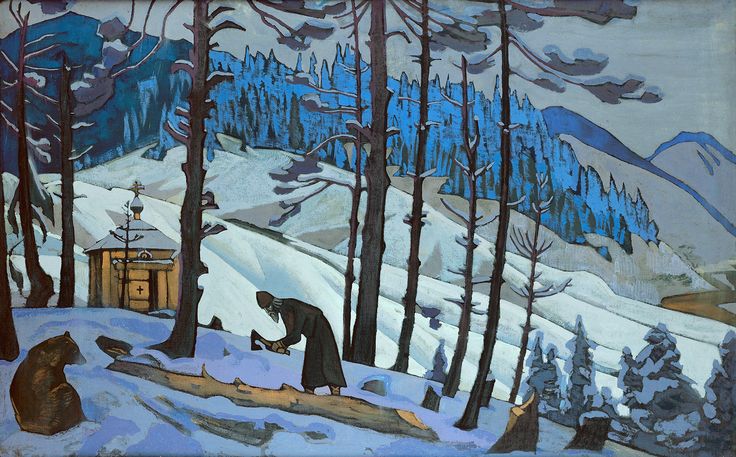
Painting by Nicholas Roerich
[1] Jamphel Yeshe Gyaltsen Tibetan: ཐུབ་བསྟན་འཇམ་དཔལ་ཡེ་ཤེས་རྒྱལ་མཚན་, Dagpo, 1910 – Lhasa, 1947) was a Tibetan tulku and the fifth Reting Rinpoche.
This I’m waiting for; thank you very very much, Rinpoche
Dear Rinpoche, your biography is interesting. After reading this Episode Four on the “Hidden Lands”, i think i have a slight notion of what your new book “The Guru Drinks Bourbon? ” mentioned about not being stuck on or clinged to referrential points, rational and irrational thoughts…as it will become an obstacle to those who practice the Vajrayana Vehicle.
Thank you for your sharing of your personal story.
with metta,
a bag of old bones.
Excuse me, Rinpoche.
May I ask why the people leave Khenpajong?
This is so enchanting Thankyou
Captivating. Usually I can’t be bothered reading things but this enchanted me from beginning to end. Thank you Rinpoche.
The story leads me to my vivid childhood memory in Himalaya mountains and yanuzangbu rivers. I just recalled lots of lost but beautiful memories. Those forgotten memories shaped my character and connection with nature and it’s unlocked energy.
The more I read the more you remind me of Tulshuk Lingpa, I’m sure you know who he was… Yes, you are still a ngagpa. The older you get, the more of a Nyingma master you become.
Captivating, mysterious, inscrutable.
Of course!
I hear the laughter of children playing by the river, lots of green foliage, cool and fresh air. Maybe, maybe one day I will find it again……
Dear Rinpoche, thank you for sharing your life story. Every word you wrote resonated within some part of me that turned itself into tears. I find myself crying reading the first three episodes of your memoir, especially when you wrote about the manjushri statue. It’s very strange because I am not one to cry easily and I’ve had the same reaction lately to the Usnisa Vijaya Dharani Sutra. Please keep writing, creating, and living this illusory life dear bodhisattva. May you be joyous, healthy, safe and loved always. I can’t wait to read the next chapter!
Totally mesmerized. Thukjeche Rinpoche 🙏🙏
Partway through reading “A Step Away From Paradise,” which is about Tulshuk Lingpa’s journey to a hidden land such as you describe. Amazing.
Fary tales are my favourite… they teach me more than hundred science books…unlocking a kind of comprehention not easy to describe.
I’m very happy you are writting these… may those unlock closed hearts and narrow minds bringing imesurable benefits for beings like me! <3
Is this why you remain so hidden, having been born in a hidden land?
Such beautiful storytelling! I am transported to these remarkable places. The whole idea of a hidden place is tantalising. Thank you Rinpoche!! I am quite enthralled and can’t wait to read the next chapter.
Wow! Amazing! Emaho!
Thank you so much Rinpoche for sharing with us such amazing and beautiful lifestory of Your Holiness.Everything is so captivating and magical…eagerly waiting for more Rinpoche.
Subjugator of apparent phenomena,
Conqueror of maras,
Fearless Lord of speech,
May your wish be accomplished.
As you work tirelessly to wake us from the darkness of ignorance and free us from the chains of karma,
And unveil to us the secrets of the wisdom paths so skillfully hidden in these words,
May we earn the ability to comprehend its deepest essence.
Thank you.
Thank you Rinpoche,
Right from the beginning with the title Mugwort – Born Conceived And Hatched As Something Called Human And Something Called Mugwort, I was transported into a world of magic.
Appreciate your exceptional ability to transcend the supra-mundane world and make it accessible to us mundane folks.
Reminds me when I first read the book ” Lord of the Rings ” yes I sense another epic movie in the making……..
Wow!
Thank You for letting us briefly into that Land.
tears and more tears; thank you rinpoche
?Thank you.
May you have the loooooongest possible life, filled with happiness and health, Rinpoche! Please, do not give up on us, ignorant beings – use whatever methods. Just seeing you makes me smile – with the deepest smile that has ever been produced by my body…true. The story of your life is a great teaching in itself: thanks for sharing it. So, are you a Mugwortian, or Artemisian?
Wow! Please stay in our world Rinpoche 🙂
Oh, to have been born and grown in such a magic place !…The enchantment of it! You are entirely magic, Rinpoche. Not just Holy, but Magic! and it is wonderful.
Thank you for allowing us to peek into this enchanted place of your childhood!
Thank you for being yourself.
Rinpoche, your life stories with pictures and details of your personal experience in this life – it’s like finding a treasure chest with the most interesting book in the world!
Thank you so much for sharing.
Please live long!
Beautiful written dearRinpochela, like watching a movie and at the same moment being a part of it. So magical story teller you are la. <3
Unraveling every night in my dream, every wakeable moment … i live in that world… half real half dream..
i love this entry; it is like wandering down a trail to the hidden land and i sort of forgot where i was for a second. thank you for sharing these stories with us.
Your Grandfather sounds like a truly amazing person. But wait … so was your other Grandfather. And your Father, and , You actually…
How fortunate are we!
Thankyou so much Rinpoche..every word awesome and inspiring,so moving.Stirs a longing deep inside to return home.
This explains alot ,to be born in a hidden land !.Why did people leave it?I would love to go there.
?
This is developing into a sensitive memoir and could have appeal to a wider audience of the man and woman in the street, which is where I hope it is going. The writing is clearer and less self-conscious. A life experience worth telling and listening to.
More please!!!!
I m longing for the hidden lands. Thank you, Rinpoche, for such beautiful n touching life stories which inspire and move me into tears.
The idea of Hidden Lands is something I think many people can relate to. Enlightenment may seems a bit far fetched and unattainable, but talk of hidden lands hits on a common thread. Maybe that’s what is so very special about them
+ Damn amazing writing by the way.
My hidden land is my hidden self in this apparent body of me, mine and I. When will I ever discover the truth and bust this mystery forever? I feel obscured by ignorance and bound to Samsara forever. When will favorable circumstances come for me so that I can also break myself away from this mess I am in today? How long should I have this longing mind with no time for practice in an isolated place free from the distraction of this world? I am a very unlucky man.
May all beings no longer have to abide in a world limited by rational thought! 🙂
Thank you. So pure and authentic.
Beyul? Dependent on a state of mind?
Louisa, I heard that everything is a state of mind.
Yes Lingchen. And Rinpoche’s state is very inspiring.
Fascinating. Thanks.
Wow! I wish I could visit a hidden land in this life time and become a ultimate hippie.
Thanks.Keep them coming, please.
Some how I am crying over everything being written for no apparent reason.
It is pretty thick with unassuming devotion. I too wept a lot, particularly this and the last one.
Should i try write the next chapter, not that i know everything but as a supplication to the one called mugwort-born who changed everthing i know?
Dear Rinpoche la
So strange and yet familiar, the story of old people’s stories around a hearth. The skill of your hands in weaving a tale between two realities steeped in truth. I feel the certainty of yours in the image of your grandfather’s, in finding the often too hidden and remote path to my believing heart.
Please bless me and all confused beings like me, that we may gather merit the way your grandfather gathered juniper seeds – enough to be reborn endlessly awake in the pure and secret landscape of bodhicitta – and offer its subtle essence to others the way you extend it to us. May you live long and well… and may we partake together in the ever changing and immovable feast of the most profound love – like ultimate hippies around a fire.
Rinpoche, love you for this and so many other things you do and say and write, and….
For some reason, having been to Bhutan, “the last Shangri-La” and coming across his name in one of my favorite books, At the Mountains of Madness, I fell in love with the paintings of Nicolas Roerich. That you love his paintings too makes me think this is an auspicious connection Rinpoche. Thank you for sharing your story Rinpoche, it means a lot to me. Maybe I will find a Hidden Land too someday- maybe I could go back to Bhutan, that beautiful country you call home
cry cry cry
Yes, we will meet, where is nothing to fight over …
The truth is a pathless land, as Krishnamurti said and
“I have nothing against of what is happening”
So, if may be, meet you in this lifetime or not – I am on the path as long as necessary, knowing that ultimatly I have to let it go.
Thank you, Yangsi, for your enthusiasm, humor and strenght, which sounds accross to far off.
Rinpoche,
greenhaired, half nacked posing, fearless,
wise, kind – thats whats reflecting from you.
You are a child of time and
our beloved reborn benefitting
Rinpoche.
May you live long ( and crazy)
Is there a way to subscribe or be notified of newly posted chapters of this fascinating unfolding autobiography?
No, sorry, there is no auto alert. But it will be announced on Facebook and in the KF Focus.
Thank you for bringing to us the flavour of these magical places, Rinpoche. I shall aspire to discover hidden lands. Please write more fairy-tales. Our lives are too concrete.
Your sharing is just priceless. Prayers from the Heart for your long healthy life for the benefit of all sentient beings, Rinpoche. So much gratitude…
A fitting article to reread on 3rd day of Kalachakra empowerment.
As I read the book ‘the brilliant moon’. I had a sincere aspiration to read about Dzongsar khyentse Rinpoche. Now, with this upcoming episodes about rinpoche, there is nothing great I can wish for. It is really great to know about the great saints from such piece.Thank you so very much to Rinpoche for coming up with this. 🙏🙏🙏
I read all episodes and i can’t wait to read it more. Thank you la Rinpoche for sharing your life story. I shared the stories with my mom who was once a student of Rinpoche Lama Sonam Zangpo and she was at Khenpajong at her younger age with the Rinpoche Lama Sonam Zangpo. She told me the stories of how she was privileged to carry little Rinpoche while travelling from Norbu Dramthang, Kurtoe and many more stories.
Thank you for all the inspiring stories. “Chapsuchoe”
Tashi Delek, Rinpoche la. Thank you so much for sharing your beautiful story. Would you recommend any literature about Hidden lands, please?…Is it the picture of The great spirit of Himalayas ?
Dear Rinpoche, I absolutely love your story-telling! Please tell us more about your grandparents, especially Lama Sonam Zanpo. Inspiring and riveting. May you continue to guide many in the years to come! Wish I could enter one of the hidden lands of Guru Rinpoche!
^..^ /
/_/\____/
/\ /\
/ \/ \
Woof, woof, meow?
/^v^\
~~~~~~~~/^v^\
~~~~^~~~~~~~~~~^~~~~~~__v_
~~~~~~~~~~~~~~~~~~~~~(____\/}
^..^____/
/_/\____)
>-</\""/\
Circles?
Shamans are all over the world. Beautiful.
Due to the incorporation of Johanniskraut you have male and female nature to equal parts, right.
As I do have due to elder.
The finest people marry the two sexes in their own person. Said Ralph Waldo Emerson
Metta to precious Rinpoche and all beings in this world
The finest people marry the two sexes in their same person. -R.W. Emerson
Maybe the Johanniskraut’s exposure was conducive to your male body, Rinpoche.
Inasmuch as elder may have been to my female body.
I pay homage to Your Amazing Noble Glories Mind, Bodhisattvaya. Please guide us to a hidden diamond land of our own mind and by the great power of Your generosity we may all get there now in instant.
Thank You Precious Rinpoche la, we are so grateful.
Hi there are indeed hidden lands here on Turtle Island. Time can be different and expand for a while and then come back to this “regular time” btw some do not consider the Don Juan books a very valid source about Indigenous wisdom here. Many Yaqui people are here in Tucson btw. My grandma was Miami Myaamia. some say we crossed the Beiring Strait but we have other stories that start here. there can be differing timelines perhaps at the same time. Many worlds on one Mother Earth, great Bodhisattva Mother Earth who witnessed Buddha’s enlightenment.
Thankyou Rinpoché , I deduce you must have been the “task set out to be accomplished ‘in Khenpajong,as every body left shortly afterward your birth ,I would love to find a hidden land.Once again..many thanks .
Wonder~full!! You have the amazingly good qualities (merit) to have been blessed
to live this life the magical Vajrayana way from a couple of hundred years ago.
Thank You for your stories~they just confirm what my inner self has been telling me
for decades…
The first evening that I spent in Kathmandu I dreamt of a cave with a Large golden Buddha beneath Swayambhunath. There was a reflecting pool of water in front of the Buddha where I left a blue flame floating above the waters. The following day the Lama that I was traveling with told me that it was one of Nicolas Roerich’s paintings.